
We've been running The Noble Cache as a Top Rated Plus eBay store out of Pensacola, FL for years now, and we've crossed 3,200+ sales. At that volume, a bad eBay inventory storage system doesn't just cost you time — it costs you your seller metrics. A late shipment hits your defect rate. Miss it entirely and you're issuing a cancellation.
This post walks through the exact system we use to store, label, and locate every single piece of inventory we carry. No apps required. No fancy software. Just a grid, some bins, and a discipline about logging locations before you walk away.
If you're just starting out, check out our guide on how to start an eBay store from scratch first, then come back here once you're ready to build real infrastructure.
The Core Workflow (This Is the Whole System)
Before we get into zones and bins, understand the order of operations. This sequence is non-negotiable:
- 1 Photograph the item first.
- 2 While the listing draft is being created, assign a storage location.
- 3 Put the location code into the listing draft.
- 4 Then put the item away.
That's it. The location lives in the listing. When the item sells, you open the order, see the location code, walk directly to it, and pull it. Under 60 seconds, every time.
The mistake most sellers make is photographing an item, setting it down somewhere, and planning to "deal with it later." There is no later. You will forget. You will regret it. Assign the location during the listing workflow, not after.
Zone Overview: Where Everything Lives
We split our inventory across four zones based on item type, size, fragility, and volume. Here's the high-level breakdown before we go zone by zone:
| Zone | Location | What Goes There | Location Code Format |
|---|---|---|---|
| Bin Racks (A–H) | Garage | Most general inventory | A1, B3, D5 |
| Metal Shelf | Office (climate controlled) | Small, delicate, or valuable items | Metal Shelf Box S3-2 |
| Media Room | Dedicated room | DVDs, VHS, games, CDs, books | Media Rack 1 / Shelf |
| Den | Den/living area | Framed art, antiques, hanging items | Den Wall / Den Display |
Zone 1: The Bin Rack System (Main Garage Storage)
This is the backbone of our eBay inventory storage system. Most of our non-media, non-fragile inventory lives here.
We built two large wooden bin racks from scratch in the garage. Each one holds 27-gallon black and red plastic storage bins — the kind with locking lids. Sturdy, stackable, cheap, and they hold a ton of stuff.
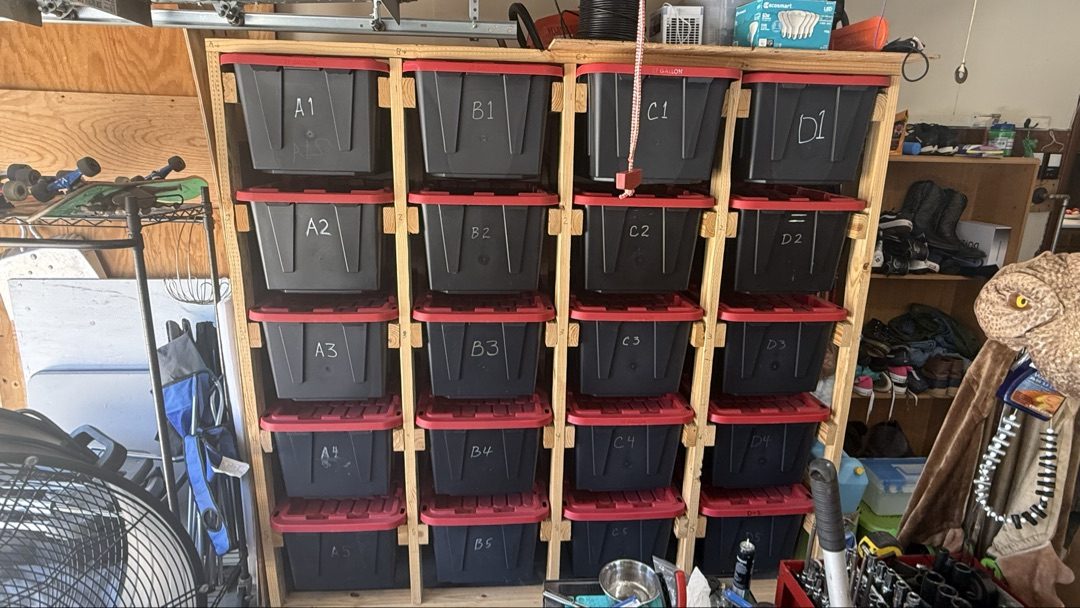
Rack 1 — Columns A through D, 5 bins tall
This was our first rack. We built it to hold five bins high to maximize vertical space. Lesson learned: the top row is a pain. Loading and unloading bin A5 or D5 means reaching overhead with a heavy bin, which is awkward and honestly a little unsafe if it's loaded with tools. If we were doing it again, we'd cap it at four high.
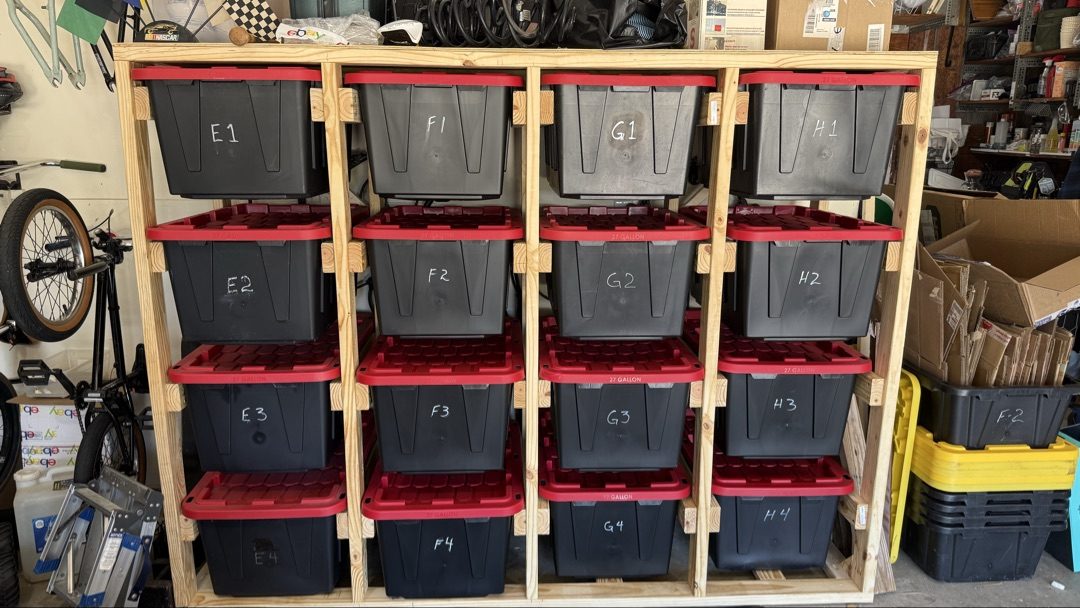
Rack 2 — Columns E through H, 4 bins tall
The second rack is four bins tall, and it's noticeably better to use. Every bin is within comfortable reach. We also added a plywood shelf across the top of each rack for oversized items — things that are too bulky for a bin but durable enough to handle the garage environment. Think large power tools, big plastic parts, anything that won't be hurt by temperature swings or humidity.
Total across both racks: approximately 32 bins.
The Grid Labeling System
The bins are labeled like a spreadsheet: letter for the column (A through H), number for the row (1 from the bottom up). So A1 is the bottom-left bin on Rack 1. D5 is the top-right bin on Rack 1. H4 is the top-right bin on Rack 2.
When we list an item going into the garage, the location code in the draft looks like this: Bin C3 or Bin F2. That's all we need.
Pro Tip
Don't overthink the labeling. A letter and a number is all it takes. You don't need color coding, QR codes, or anything else. The simpler the system, the faster it works at 2am.
Build Cost
Each rack cost us about $200 including lumber and bins — roughly $400 total for both racks. That's a real, permanent infrastructure investment for a reselling operation, and it's cheaper than one month of a storage unit.
What goes in the bins: General merchandise — tools, sporting goods, collectibles, kitchenware, décor, hardware, and anything that isn't fragile or temperature-sensitive.
What stays out of the bins: Electronics, small parts that would get lost in a big bin, high-value items, and anything that could be damaged by garage heat or humidity.
Zone 2: The Metal Shelf (Office, Climate Controlled)
For anything that can't handle the garage, we use a metal wire shelving unit inside the office. Climate controlled, organized, and dedicated to the stuff that needs more care.
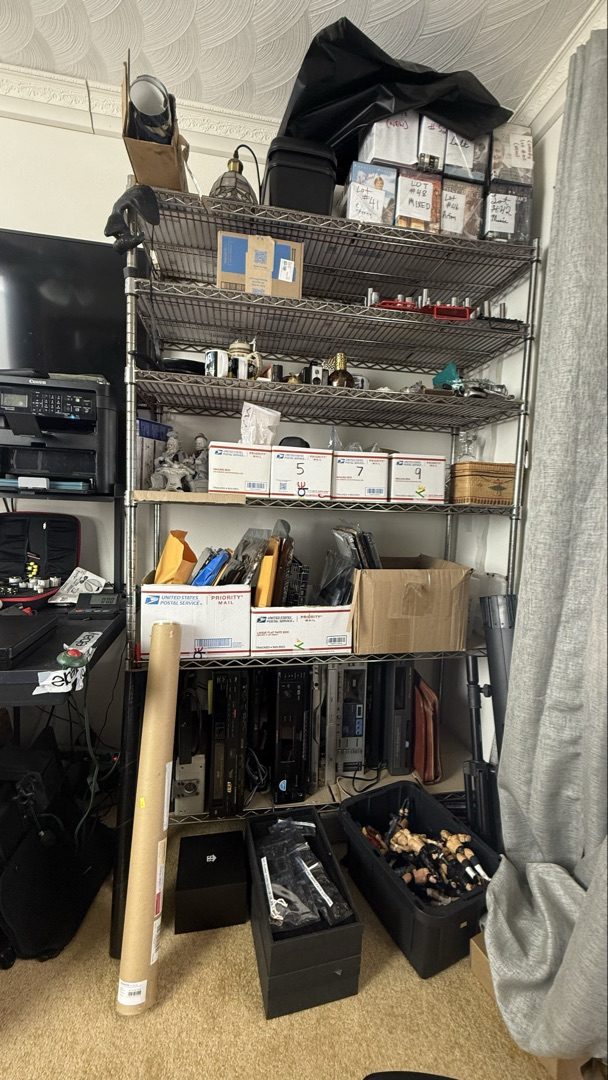
What lives on the metal shelf:
- Small numbered boxes (
S1throughS10-ish): About ten 8×8 cardboard boxes, each numbered. These hold small items that would rattle around or get lost in a 27-gallon bin — jewelry, small hardware, figurines, vintage pins, etc. - Socket organizers: We use socket organizer trays to hold sockets sorted by drive size and whether they're SAE or metric. Each socket has a specific tray slot. The location code for a socket we're selling might be
Metal Shelf — Socket Tray 3/8 Metric. - Wrenches and misc mechanic tools: Their own dedicated box on the shelf.
- Bottom shelf: Electronics too large for a bin — think vintage receivers, handheld game consoles, or anything with a screen.
- USPS Priority Mail boxes: We keep a supply of flat rate and regional boxes here too, which cuts packing time significantly.
Location code format: Metal Shelf Box S3-2 means the item is in small box #3, position 2 (or just "in box 3" — the position detail is optional for loose items).
The metal shelf is where we put anything we'd be upset to lose or damage. High-value items, delicate items, and small items that need to stay organized rather than floating in a big bin.
Zone 3: The Media Room
Media inventory is its own category entirely, and it earns its own dedicated room. The volume is high, the items are uniform in size, and they need to be browsable — not buried.
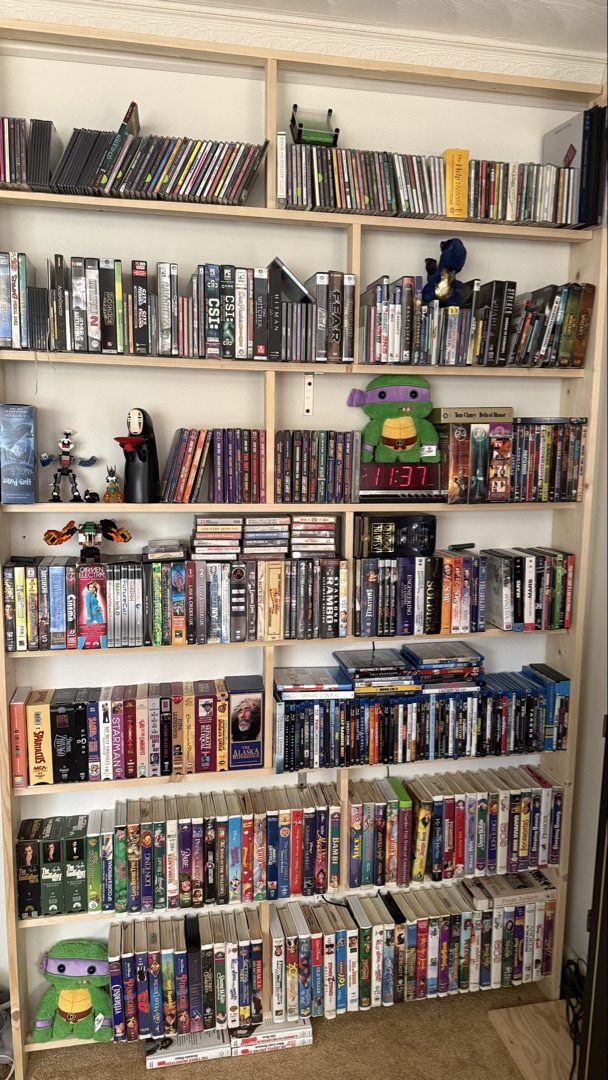
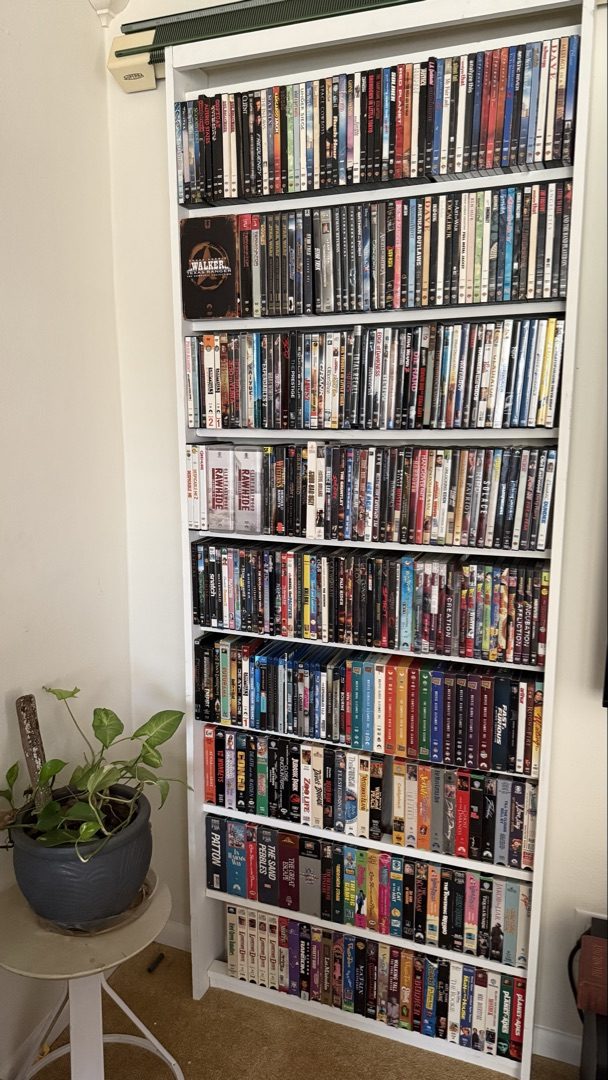
We have two floor-to-ceiling custom-built media racks — the kind designed specifically for DVD cases, VHS tapes, Blu-rays, and game cases. If you're dealing with any real volume of media, purpose-built DVD and media storage racks beat retrofitted shelving every time. The slots are the right width, the depth is right, and you can see spines at a glance.
What's stored here:
- VHS tapes
- DVDs and Blu-rays
- Video games (console and PC)
- CDs and cassettes
- Books (bookshelf on the floor level)
Every title in the media room is listed individually on eBay. When something sells, the location is straightforward: Media Rack 1 or Media Bookshelf.
The reason media gets its own zone: volume and uniformity. We might have hundreds of DVDs listed. They're all roughly the same size. They're all shelved spine-out. Finding a specific title takes seconds if it's in its zone. If DVDs were scattered across garage bins, every pick would be a search party.
Zone 4: The Den (Antiques and Wall Art)
Some inventory can't go in a bin. Framed photos, framed art prints, mirrors, and antique display pieces live in the den — hung on the walls or displayed on surfaces. It doubles as a genuinely nice-looking room and a functional storage area.
What's here:
- Framed photos and art (hung on walls)
- Antique items (displayed on shelves/surfaces)
- Larger decorative pieces that need to stay protected
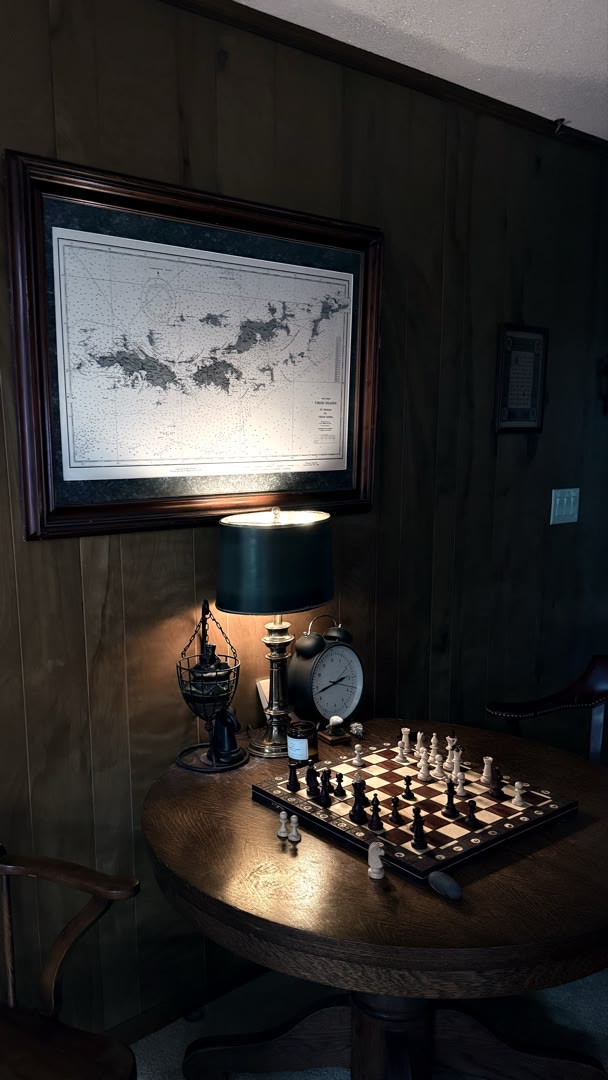
The den doubles as a display area — nautical charts, chess sets, and antique pieces live here until they sell.
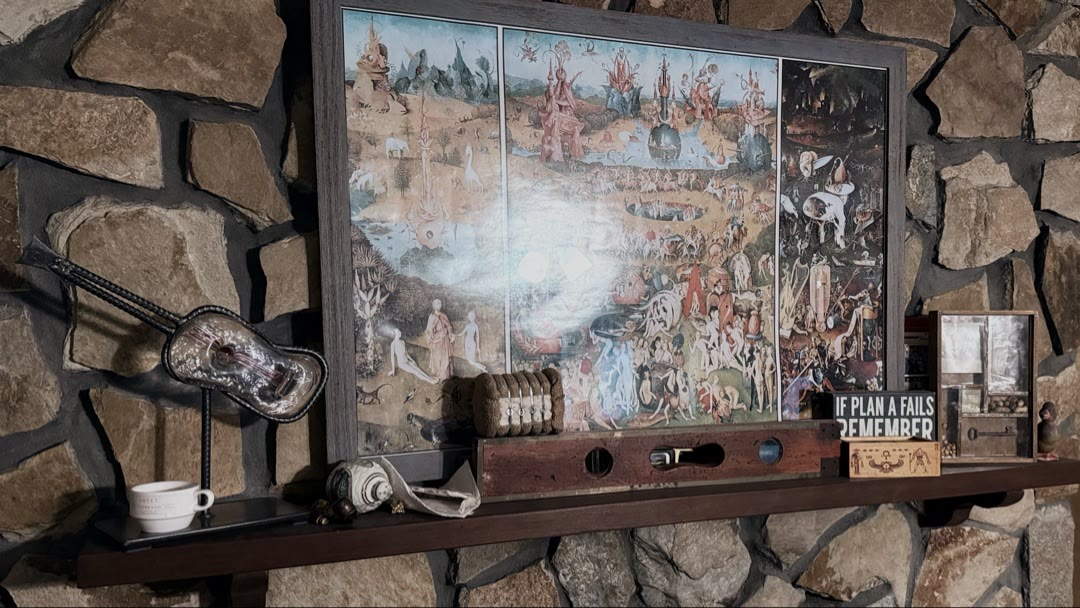
The stone mantel holds framed art, antique tools, and display pieces — every item here is an active listing.
Location codes for den items are simple: Den Wall — Left or Den Display Shelf. When something sells, we take it down, wrap it, and ship it.
How to Organize eBay Inventory: The Rules We Actually Follow
If you're building your own version of this, here's what we've learned the hard way:
Assign the location during the listing workflow, not after. If you photograph an item and walk away without logging where it went, you will lose it. The whole system breaks down the moment you make exceptions to this rule.
Climate-sensitive items go inside, durable stuff lives in the garage. Electronics, anything with labels that can peel, anything painted or coated — keep these inside. Tools, plastic bins, kitchenware — the garage is fine.
Don't go more than 4 bins tall. We went five on Rack 1 and regret it. The top bins are hard to load and unload, especially when they're full. Four high is the practical limit for a single person working alone.
Media gets its own zone. If you sell any meaningful volume of DVDs, games, or VHS, don't mix them with general inventory. The uniformity of media items makes dedicated storage worth it.
Keep the code simple. A letter and a number. Don't build a 10-character alphanumeric system. You need to be able to read the code at 2am, type it fast, and find the item without consulting a map.
What This Costs to Build
Here's the honest tally for getting a system like ours off the ground:
| Item | Approximate Cost |
|---|---|
| Lumber for Rack 1 (5-tall) | ~$75 |
| Lumber for Rack 2 (4-tall) | ~$60 |
| 27-gallon bins (×32) | ~$130 |
| Metal wire shelving unit | ~$80 |
| Small numbered boxes | ~$20 |
| Socket organizer trays | ~$25 |
| Media racks (custom-built) | ~$100 |
| Total | ~$490 |
You can get this whole system stood up for under $500. We've seen sellers spend more than that on a single piece of shelving from a big-box store. Build it yourself, label it right, and it'll outlast your eBay store.
Quick Reference: The Noble Cache Inventory System
Bookmark this section.
| If the item is… | It goes in… | Location code looks like… |
|---|---|---|
| General merchandise, tools, décor | Garage bin rack (A–H) | Bin C3, Bin F1 |
| Small, delicate, or valuable | Office metal shelf | Metal Shelf Box S4 |
| Electronic, larger than a bin | Office metal shelf (bottom) | Metal Shelf Bottom |
| DVD, VHS, game, CD, book | Media room rack/shelf | Media Rack 1, Media Bookshelf |
| Framed art, antique, wall piece | Den | Den Wall, Den Display |
The workflow, always:
- 1 Photograph
- 2 Assign location (during listing draft)
- 3 Log location code in draft
- 4 Put item away
Reseller Storage Ideas That Don't Work (And Why)
Piling items on a table "temporarily." There is no temporary. Items on tables become invisible. They get buried, knocked over, or listed with no location.
Using room names alone as locations. "It's in the office" is not a location. Metal Shelf Box S3 is a location.
Mixing media with general inventory. You'll spend five minutes per pick sorting through bins for DVDs. Volume media needs dedicated space.
Going too tall on your racks. Five high seemed efficient until we had to unload a full bin of tools from overhead. Four is the ceiling (no pun intended).
Final Thoughts
Our eBay inventory storage system isn't complicated. It's two wooden bin racks, a metal shelf, a media room, and a den. The real system is the discipline of logging locations during the listing workflow — before you walk away from the item.
If you're dealing with late shipments, canceled orders, or just spending too much time hunting for sold items, the answer isn't more space. It's a grid system with location codes baked into every listing.
Get the bins labeled, build the habit, and you'll never spend another 2am turning the house upside down for a socket set.
"The sellers who consistently outperform aren't the ones with the most inventory or the lowest prices. They're the ones whose operations are tight enough that nothing slips through the cracks."
Want help making sure your listings are actually converting once buyers find them? If your inventory is organized but your sales feel flat, the problem might be the listings themselves. Check out our listing optimization services — or read our breakdown of why your eBay listings aren't selling to diagnose the issue yourself.
Already Have Inventory?
Organized inventory is only half the battle. If your listings aren't getting found, we can help — title optimization, item specifics, pricing strategy, and more.
See Our Services →The Noble Cache is a Top Rated Plus eBay seller based in Pensacola, FL with 3,200+ sales. The Reseller's Edge is our blog covering the operational and strategic side of running a high-volume reselling business.
Some links in this post are affiliate links. If you purchase through them, we may earn a small commission at no extra cost to you. We only recommend products we actually use.
Related Reading